
Sun, Nov 8, 2026
[Archive]
Volume 11, Issue 4 (11-2026)
J Nutr Food Secur. 2026, 11(4): 662-682 |
Back to browse issues page



Download citation:
BibTeX | RIS | EndNote | Medlars | ProCite | Reference Manager | RefWorks
Send citation to:


BibTeX | RIS | EndNote | Medlars | ProCite | Reference Manager | RefWorks
Send citation to:
Karkhaneh M, Shafiei F, Pakravan-Charvadeh M R, Mohammadi-Nasrabadi F. Household Coping Strategies for Food Insecurity: An Overview of Reviews. J Nutr Food Secur. 2026; 11 (4) :662-682
URL: http://jnfs.ssu.ac.ir/article-1-1650-en.html
URL: http://jnfs.ssu.ac.ir/article-1-1650-en.html
Maryam Karkhaneh  , Fateme Shafiei , Mohammad Reza Pakravan-Charvadeh , Fatemeh Mohammadi-Nasrabadi *
Institute (NNFTRI), Faculty of Nutrition Sciences and Food Technology, Shahid Beheshti University of Medical Sciences, Tehran, Iran
Full-Text [PDF 688 kb]
(45 Downloads)
| Abstract (HTML) (430 Views)
Full-Text: (9 Views)
Household Coping Strategies for Food Insecurity: An Overview of Reviews
Maryam Karkhaneh; PhD Candidate 1, Fateme Shafiei; PhD Candidate *1,
Mohammad Reza Pakravan-Charvadeh; PhD 2 & Fatemeh Mohammadi-Nasrabadi; PhD 3
Mohammad Reza Pakravan-Charvadeh; PhD 2 & Fatemeh Mohammadi-Nasrabadi; PhD 3
1 Department of Community Nutrition, Faculty of Nutrition Sciences and Food Technology, National Nutrition & Food Technology Research Institute (NNFTRI), Shahid Beheshti University of Medical Sciences, Tehran, Iran; 2 Department of Agricultural Economics and Rural Development, Faculty of Agriculture, Lorestan University, Khorramabad, Iran;3 Food and Nutrition Policy and Planning Research Department, National Nutrition & Food Technology Research Institute (NNFTRI), Faculty of Nutrition Sciences and Food Technology, Shahid Beheshti University of Medical Sciences, Tehran, Iran.
| ARTICLE INFO | ABSTRACT | |
| REVIEW ARTICLE | Background: Comprehensive understanding of the strategies used by households to confront food insecurity can assist governments and relevant organizations in formulating policies that are more effective. This overview of reviews aims to examine the strategies utilized by households to confront food insecurity throughout the world, regardless of its underlying causes. Methods: The authors searched in PubMed/Medline, ISI Web of Science, Scopus and Google Scholar by appropriate keywords to identify relevant publications up to March 2024. Reviews were eligible for inclusion in the current study if they mentioned coping strategies in response to food insecurity and their full text was in English. The quality of included reviews was examined by the SANRA, JBI, and PRISMA-ScR. Results: A total of 58 review studies reporting coping strategies in response to food insecurity were included. Two major groups of household coping strategies for food insecurity were highlighted: 1) Food-based coping strategies including reducing amount/ portion size of food intake, skipping meals, eating cheap foods, using less preferred food, borrowing/ requesting food options, food sharing, minimizing food waste, assistance programs; and 2) Non-food-based coping strategies which are social protection, financial and asset-based approaches, diversification of livelihood or income sources, agricultural/livestock management approaches, informal and illegal economic approaches, and human capital related strategies. Conclusion: Examining the coping strategies used by households experiencing food insecurity can offer policymakers and planners valuable insights to mitigate food insecurity and its consequences globally and regionally. |
|
| Article history: Received: 20 May 2026 Revised: 29 Aug 2026 Accepted: 29 Aug 2026 |
||
| *Corresponding author: Fateme.shafie@gmail.com Department of Community Nutrition, Faculty of Nutrition Sciences and Food Technology, National Nutrition & Food Technology Research Institute, Shahid Beheshti University of Medical Sciences, Tehran, Iran. Postal code: 19395-4741 Tel: +98 21 22360656 |
||
| Keywords: Coping skill; Coping strategies; Food insecurity.. |
Food security has long been one of the most challenging topics and a significant focus for policymakers all over the world (Akbari et al., 2022, Gebrehiwota M, 2023); it is a situation that exists "when all people, at all times, have physical, social and economic access to sufficient, safe and nutritious food that meets their dietary needs and food preferences for an active and healthy life (Food Security Information Network, 2024)(Food Security Information Network, 2024)(Food Security Information Network, 2024)(Food Security Information Network, 2024. It has four dimensions including availability, access, utilization, and stability (Akbari et al., 2022, Gebrehiwota M, 2023, Leventon J, 2017). Food insecurity arises when one, some or all these dimensions are disrupted, by various causes (Akbari et al., 2022, Hawkins M, 2021).
Food insecurity may be linked to a range of health and social implications, encompassing susceptibility to physical and psychological health issues among children, as well as increased vulnerability to conditions like obesity, diabetes, cardiovascular disease, and mortality among adults(Dlamini S N, 2023, Hawkins M, 2021, Laraia, 2013, Otekunrin, 2024). Food insecurity can be chronic, which is when it persists over time, primarily due to structural causes, or acute, which means that it occurs at a specific point in time and of a severity that threatens lives, livelihoods, or both, regardless of the causes, context or duration (Akbari et al., 2022). Chronic and acute food insecurity are overlapping concepts and can coexist rather than being entirely exclusive; an area or a specific population may experience either situation or even both, concurrently (Akbari et al., 2022, Integrated Food Security Phase Classification, 2015). Food crises are more likely among populations already suffering from prolonged food insecurity and malnutrition, and in areas where structural factors increase their vulnerability to shocks (Akbari et al., 2022). In the year 2024, approximately 28.9% of the global population -equivalent to 2.3 billion individuals - experienced moderate to severe food insecurity(Food Security Information Network, 2024). Disparities are evident, with 71.5% of the population in low-income countries unable to afford a healthy diet, compared to 52.6% in lower middle income, 21.5% in upper-middle-income, and 6.3% in high-income countries.
Several reasons exacerbate the levels of food insecurity worldwide such as the emergence of pandemics like COVID-19, wars and conflicts, poverty, rising disparities, marginalization, lack of access to basic services, soaring food costs, water scarcity, biofuel production, and a lack in public and private investment in infrastructure (Akbari et al., 2022, Dasgupta and Robinson, 2022, Fyles H, 2016, Otekunrin, 2024). Climate change and environmental emergencies also have a significant impact on food insecurity. These effects can be caused by the alteration of multiple factors including crop production, food affordability, stability and access to food resources, prices, markets, and infrastructure throughout the food chain, decrease in income, and increase in the incidence of infectious and diarrheal diseases (Dasgupta and Robinson, 2022).
Many shocks, including wars, climate change, environmental emergencies, and economic disruptions can significantly affect household livelihoods and various forms of capital—physical, human, and social. These events may hinder households' ability to meet their needs by disrupting production, distribution, markets, and income generation. Coping strategies could be defined as a series of adaptive behaviors implemented to tackle particular external or internal stressors or shocks that exceed a household's existing resources or capacities (World Food Programme, 2023). Households employ a range of coping strategies, from short-term consumption-based methods to long-term livelihood approaches aimed at addressing food insecurity. These strategies vary based on the crisis's causes, types, and household characteristics such as socio-economic status, income, and education (Errico M, 2023, World Food Programme, 2023). Research indicates a variety of mixed approaches to mitigate food insecurity, including choosing cheaper food options, begging, utilizing public and private assistance programs, leveraging social networks, and adopting other nutrition and financial strategies, which may help prevent changes to the quality and quantity of the diet (Dlamini S N, 2023, Kamdar et al., 2019). An in-depth knowledge and understanding of the coping strategies adopted by households in facing food insecurity can guide future interventions and help policymakers gain insights and formulate policies with more efficiency to tackle food insecurity.
This study examines existing review literature regarding the strategies households use to cope with food insecurity worldwide, regardless of its underlying causes, by categorizing and organizing of these strategies. This review framed frequency more modestly as a bibliometric or synthesis-related indicator rather than effectiveness or an implicit basis for policy prioritization.
Materials and Methods
Search design
Synthesizing review data can provide robust evidence to support more informed decision-making (Pollock M, 2024). Given the growing number of review articles exploring coping strategies in the context of food insecurity, the authors adopted an overview of the reviews’ design to synthesize the existing evidence comprehensively. This approach allows for the integration of findings from multiple reviews, providing broader insights to inform policy and practice.
Search strategy
The authors performed systematic searching on PubMed/Medline, ISI Web of Science, and Scopus up to March 2024 for finding previously published review studies in the field of coping strategies and food insecurity. They used the following keywords: (“Food secur*” OR “Foodinsecur*” OR “Malnutr*” OR “Nutr*” OR “Pover*” OR “Poor*” OR “Hung*”) AND (“Coping*” OR "Resilien*” OR “Livelihood*” OR “Adapt*” OR “Surviv*"). No time limitation was applied. They also checked the Google scholar (10 pages) and reference lists of included studies to avoid missing any relevant publication.
Inclusion and exclusion criteria
Two reviewers (Karkhaneh M and Shafiei F) independently screened all search results to identify potentially eligible studies based on an internal protocol for screening and data extraction. They discussed any conflicts until reaching an agreement, and the third reviewer (Mohammadi-Nasrabadi F) resolved any disagreement. Titles and abstracts were reviewed to determine which articles reported coping strategies for food insecurity. Moreover, studies were eligible for inclusion if they met the following criteria: 1) Any type of review studies mentioning “coping strategies” as adaptive behaviors used by households to address food security stressors exceeding their resources; 2) Full texts available in English.
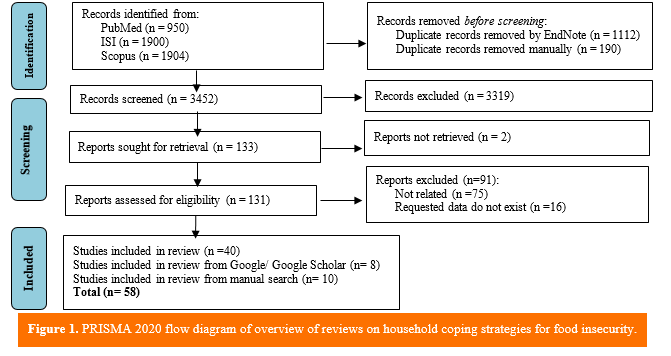
The authors excluded letters, commentaries, cross-sectionals, cohorts, clinical trials, and animal studies from the current study. They did not include unpublished studies or grey literature in this analysis. In total, 4754 articles were found in the initial search. Duplicate records were removed by EndNote (n=1112) and 190 duplicate records were removed manually; therefore, 3452 articles remained for screening. Based on title and abstract screening, 3319 studies were excluded and 133 articles remained for retrieval, and two of them (Feichtinger, 1995, Thomas and Leatherman, 1990) were not retrieved; so, 131 potentially relevant papers remained for eligibility assessment. 91 papers were excluded because of failure to report the coping strategies in response to food insecurity used by households. After these exclusions, 40 studies remained for the current review, as well as 8 studies included in this review from manual search of Google/Google Scholar and 10 from backward manual citations search. Therefore, a total of 58 review studies were included in our review (Figure 1). ADDIN EN.CITE.DATA ADDIN EN.CITE.DATA (Ahmad and Farooq, 2010, Ahmed Mumed et al., 2023, Alaimo, 2005, Ansah et al., 2019, Ardalan et al., 2019, Bazerghi et al., 2016, Campbell, 1990, Castells-Quintana et al., 2018, Chaudhuri et al., 2021, Corbett, 1988, Deckard and Auyero, 2022, Douglas, 2023, Endalew et al., 2015, Falco et al., 2018, Fan et al., 2022, Fayemi et al., 2018, Few, 2003, Hadley and Crooks, 2012, Haile, 2005, Hoffmann et al., 2022, Ivers and Cullen, 2011, Kamdar et al., 2019, Kiehne and Mendoza, 2015, Kregg-Byers and Schlenk, 2010, Krishna et al., 2018, Lee et al., 2018, Leroy et al., 2015, Long et al., 2020, Maynard et al., 2019, Megerssa and Bekere, 2019, Melese, 2021, Melton, 2018, Mohamed, 2017, Morales-Muñoz et al., 2020, Morton, 2007, Munialo and Mellor, 2023, O'Farrell et al., 2009, Omomowo and Babalola, 2021, Patel et al., 2019, Peng et al., 2018, Piaskoski et al., 2020, Pitt et al., 2017, Renzaho and Mellor, 2010, Rijal et al., 2022, Ruel et al., 2010, Saediman et al., 2021, Seligman and Berkowitz, 2019, Sewnet, 2015, Shemyakina, 2022, Sherly Ardi Vantono, 2022, Sirany et al., 2022, Siwar et al., 2014, Sulaiman et al., 2021, Tabe-Ojong et al., 2023, Vilar-Compte et al., 2021, Watson et al., 2022, Wekeza et al., 2022, Yusa et al., 2015)
Data extraction
Two independent reviewers (Karkhaneh M and Shafiei F) extracted the data with discrepancies resolved through discussion or consultation with a third reviewer. Extracted information included study characteristics (first author, publication date, review design, number of primary studies included, their time frame, countries, total number of participants in primary studies, number of databases searched, search terms provided, language restrictions, and quality or bias assessment.
Quality assessment
Majority of the included reviews did not state quality or bias assessment of their primary studies. The authors examined the quality of the included reviews by the SANRA (Scale for the Quality Assessment of Narrative Review Articles) (Baethge et al., 2019), JBI (The Joanna Briggs Institute) critical appraisal checklist for systematic reviews and research syntheses (Aromataris et al., 2015), and PRISMA-ScR (Preferred Reporting Items for Systematic reviews and Meta-Analyses extension for Scoping Reviews) (Tricco et al., 2018). SANRA has the six items which are rated from 0 (low standard) to 2 (high standard): Explanation of the review’s importance (item 1), Statement of the aims of the review (item 2), Description of the literature search (item 3), Referencing (item 4), Scientific reasoning (item 5), and Presentation of relevant and appropriate endpoint data (item 6). The maximum sum score achievable is 12. In this scale, a score of 4 or below indicates very poor quality (Baethge et al., 2019). The JBI checklist has 11 questions to guide the appraisal of systematic reviews or meta-analyses. Each question should be answered as “Yes”, “No”, or “Unclear”. Not applicable “NA” is also provided as an option and may be appropriate in rare instances. Based on the answers to these questions, overall appraisal results in this checklist could be included, excluded, or sought further (Aromataris et al., 2015). Based on the result of quality assessment, all systematic review studies were included.The PRISMA-ScR checklist contains 20 essential reporting items and 2 optional items (Tricco et al., 2018). As a reporting checklist rather than a methodological quality tool, the PRISMA-ScR provides sufficient detail of the study process for the two scoping reviews in this study.
Overall, the quality assessment indicates both the strengths and areas for improvement in review study quality, underscoring the importance of transparent reporting and rigorous methodology in evidence synthesis.
Data synthesis
Findings from the included reviews were synthesized narratively. Coping strategies were grouped into thematic categories based on similarity and frequency of reporting across reviews. Patterns were identified in relation to geographic context, population vulnerability, and type of coping strategies addressed.
Results
58 reviews were included in the present study and are presented in Table 1. This table compiles characteristics of review studies related to household coping strategies in response to food insecurity. The designs of these reviews were mostly literature, narrative, and scoping. Number of primary studies included in these systematic reviews ranged from 10 to 89. Time frame of primary studies of these reviews was mostly after 2000. One study was reported from Nepal (Rijal et al., 2022), one from Malaysia (Sulaiman et al., 2021), two from USA (Kamdar et al., 2019, Kiehne and Mendoza, 2015), and others were multi-countries .
One of the systematic reviews was accompanied by meta-analysis (Fan et al., 2022) and also there was a meta-analytical review (Hoffmann et al., 2022). Due to the different purposes of these studies, the information related to their statistical meta-analyzes was not included in the tables. Following the quality assessment, none of the included review studies were excluded, despite their diversity (systematic reviews, scoping reviews, and narrative reviews). In general, in some of the included review studies, the countries where the primary studies were conducted were not specified. Others were from High Income Countries (HICs) (Bazerghi et al., 2016, Douglas, 2023, Kamdar et al., 2019, Kiehne and Mendoza, 2015, Lee et al., 2018, Maynard et al., 2019, Piaskoski et al., 2020, Pitt et al., 2017, Saediman et al., 2021, Siwar et al., 2014, Sulaiman et al., 2021, Watson et al., 2022, Yusa et al., 2015), Low- and Middle-Income Countries (LMICs) (Ahmed Mumed et al., 2023, Ansah et al., 2019, Ardalan et al., 2019, Campbell, 1990, Corbett, 1988, Deckard and Auyero, 2022, Endalew et al., 2015, Falco et al., 2018, Few, 2003, Haile, 2005, Hoffmann et al., 2022, Krishna et al., 2018, Megerssa and Bekere, 2019, Melese, 2021, Mohamed, 2017, Morales-Muñoz et al., 2020, Patel et al., 2019, Rijal et al., 2022, Sirany et al., 2022, Tabe-Ojong et al., 2023, Vilar-Compte et al., 2021), and mixed of HICs and LMICs (Chaudhuri et al., 2021, Fan et al., 2022, Hadley and Crooks, 2012, Kregg-Byers and Schlenk, 2010, Sherly Ardi Vantono, 2022). The food-based coping strategies in response to food insecurity in HICs and LMICs were not entirely similar. Public assistance programs such as WIC (special supplemental nutrition program for Women, Infants, and Children), school meal programs, and particularly SNAP (Supplemental Nutrition Assistance Program) are the top food insecurity coping mechanisms in HICs like the USA. However, many HICs tend to provide much broader cash assistance.
| Table 1. Summary of the characteristics of the included reviews on household coping strategies for food insecurity. | ||||||||||
| No | Author (year) | Review design | Number of primary included studies | Time frame of primary studies | Countries where primary studies were undertaken | Total number of participants in primary studies | Number of databases searched | Search terms provided | Language restrictions | Quality or bias assessment |
| 1 | Douglas et al. (2023) | Literature review | NS | NS | United Kingdom | NS | NS | NS | NS | NS |
| 2 | Mumedet et al. (2023) | Literature review | NS | NS | Ethiopia | NS | NS | NS | NS | NS |
| 3 | Munialoet et al. (2023) | Literature review | NS | NS | NS | NS | NS | NS | NS | NS |
| 4 | Tabe-Ojanget et al. (2023) | Systematic review | 44 | 2020-2022 | Multi-country | NS | 2 + Grey literature | Yes | Yes | No |
| 5 | ArdiVantonoet et al. (2022) | Literature review | 17 | September to December 2020 and May to December 2021 |
Asia, Europe, Oceania, and the Americas (USA), Sub-Saharan Africa, Central Zambia, Myanmar, Bangladesh, Pakistan, Egypt |
NS | 4 | Yes | Yes | Yes |
| 6 | Deckard et al. (2022) | Annual review |
NS | NS | Mexico, Rio de Janeiro, and other Latin American countries | NS | NS | NS | NS | NS |
| 7 | Fan et al. (2022) |
Systematic review and meta-analysis | 10 | 2019 - 2021 | Kenya, Cameron, China, Jamaica, California, (America), Iran, Niger, Tunisian, Indonesia | 3671 | 5 | Yes | Yes | Yes |
| 8 | Hoffmann et al. (2022) | Meta-analytical review | 53 | 2004 - 2019 | 22 countries in sub-Saharan Africa | More than 21 thousand households | 1 | Yes | Yes |
NS |
| 9 | Rijalet et al. (2022) | Systematic review | 36 | 2000-2021 | 1 (Nepal) | NS | 3 | Yes | Yes | Yes |
| 10 | Shemyakinaet et al. (2022) | Literature review | NS | NS | NS | NS | NS | NS | NS | NS |
| 11 | Siranyet et al. (2022) | Analytical review | 86 | NS | 1 | NS | 5 | Yes | NS | NS |
| 12 | Watson et al. (2022) |
Scoping Review | 18 | NS | 6 | Variable | 3 | Yes | No | NS |
| 13 | Wekezaet et al. (2022) | Systematic review | 37 | Yes | NS | NS | 2 | Yes | Yes | NS |
| 14 | Malese (2021) | Literature review | NS | NS | Ethiopia | NS | NS | NS | NS | NS |
| 15 | Chaudhuri et al. (2021) | Systematic literature review | 89 | 2000-2020 | Reported regional income classification | NS | 10 | Yes | Yes | NS |
| 16 | Omomowo &Babalola (2021) | Literature review | NS | NS | NS | NS | NS | NS | NS | NS |
| 17 | Saedimanet et al. (2021) | Literature review | NS | NS | 1 (Indonesia) | NS | NS | NS | NS | NS |
| 18 | Sulaimanet et al. (2021) | Systematic literature review | 46 | 2000-2020 | 1 (Malaysia) | |||||
| 19 | Vilar-Compteet et al. (2021) | Global systematic literature review | 68 | 2000-2019 | Sub-Saharan Africa, North America, Latin America & Caribbean, South Asia, East Asia & Pacific, Europe & Central Asia, Middle East & North Africa |
NS | 4 | Yes | Yes | Yes |
| 20 | Long et al. (2020) |
Literature review | NS | NS | NS | NS | NS | NS | Yes | NS |
| 21 | Morales-Muñoz et al. (2020) |
Critical review | 139 | 2014 -2020 | Colombia Myanmar Tanzania |
NS | 2 | Yes | NS | NS |
| 22 | Piaskoskiet et al. (2020) | Qualitative systematic review | 32 | Any time | USA Canada Australia |
1481 | 5 | Yes | Yes | No |
| 23 | Ansah et al. (2019) |
Review | 28 | 2009-2018 | Developing countries | NS | 4 | Yes | NS | NS |
| 24 | Ardalanet et al. (2019) | Literature review | 20 | 2004 - 2018 | Ethiopia | NS | 5 | Yes | Yes |
NS |
| 25 | Megerssaet et al. (2019) | Literature review | NS | NS | Ethiopia | NS | NS | NS | NS | NS |
| 26 | Patel et al. (2019) | Literature review | NS | NS | 1 (Odisha, India) | NS | At least 3 | Yes | NS | NS |
| 27 | Seligman et al. (2019) | Literature review | NS | NS | NS | NS | NS | NS | NS | NS |
| 28 | Dawn Lee et al. (2018) | Narrative review |
46 | 2000 - 2017 | USA, Australia, Canada, Poland | 83,649 | 9 | Yes | Yes | Yes |
| 29 | Falco et al. (2018) | Review | NS | NS | Ecuador, Nigeria, Bangladesh, Ethiopia, Indonesia, Tanzania, Philippines | NS | NS | NS | NS | Yes |
| 30 | Kamdaret et al. (2018) |
Systematic review | 13 |
From 1995 | United States | NS | 3 | Yes | Yes | Yes |
| 31 | Maynard et al. (2018) | Scoping review | 36 | 2010-2016 | USA, Canada | 511,776 | 4 | Yes | Yes | No |
| 32 | Melton et al. (2018) |
Literature Review | Seventeenth century, specifically the period from 1650 to 1680 | NS | NS | The North Carolina Piedmont | NS | NS | NS | NS |
| 33 | Peng et al. (2018) |
Literature review | NS | NS | NS | NS | NS | NS | NS | NS |
| 34 | Abdulahi Mohamed (2017) |
Review | NS | NS | Ethiopia | NS | NS | NS | NS | NS |
| 35 | Castells-Quintana et al. (2017) | Literature review | NS | NS | NS | NS | NS | NS | NS | NS |
| 36 | Krishna et al. (2017) | Systematic review |
26 | 2000_2016 | Various countries in the Asia Pacific region: India, Bangladesh, Nepal, Philippines, Sri Lanka, Samoa Island, China |
3984 | 7 | Yes | Yes | Yes |
| 37 | Pitt et al. (2017) |
Systematic review | 30 | 2001-2015 | USA, UK, Mexico, Canada, Australia, Netherlands | 1333 | 6 | Yes (In the online supplementary material) | Yes | Yes |
| 38 | Bazerghiet et al. (2016) | Systematic review |
35 | 1998_ 2015 | Canada, United States, Australia, Netherlands |
7348 | 8 | Yes | Yes | NS |
| 39 | Fayemi et al. (2016) |
Literature review |
NS | NS | NS | NS | NS | NS | NS | NS |
| 40 | Endalewet al. (2015) | Literature review | 26 | 2002_2014 | Ethiopia | NS | NS | NS | NS | NS |
| 41 | Kiehneet et al. (2015) | Systematic literature review | 10 | 2003_2011 | United States (South, Southwest, Midwest, and Northeast regions of the United States) |
1824 Migrant and seasonal farmworkers |
2 | Yes | NS | NS |
| 42 | Leroy et al. (2015) |
Critical review | 9 indicators (Not studies) | NS | NS | NS | NS | No | NS | NS |
| 43 | Sewnet (2015) | Literature review | NS | Ethiopia | NS | NS | NS | NS | NS | NS |
| 44 | Yusaet et al. (2015) | Literature review | 136 | For Canadian and U.S. literature: 1993-2013 For the international literature: any time up to 2013 |
Canada, developed countries and particularly from the U.S., Australia, the UK | NS | For Canadian and U.S. literature: 3 For the international literature:5 |
Yes | NS | NS |
| 45 | Siwaret et al. (2014) |
Literature review | NS | NS | Malaysia | NS | 4 | Yes | Yes | NS |
| 46 | Hadley et al. (2012) |
Literature review | NS | NS | Low-income and high-income countries (such as Bangladesh, Argentina, Pakistan, Jamaica, Lesotho, Nigeria United States. Trinidad and Tobago, and urban Colombia) |
NS | 2 | Yes | NS | NS |
| 47 | Iverset et al. (2011) |
literature review | NS | NS | NS | NS | NS | NS | NS | NS |
| 48 | Ahmad et al. (2010) |
Literature review | NS | NS | NS | NS | NS | NS | NS | NS |
| 49 | Campbell et al. (2010) | Literature review | NS | NS | Rural Africa | NS | NS | NS | NS | NS |
| 50 | Kregg-Byers et al. (2010) | Literature review | NS | NS | The United States, China, India, Bangladesh, sub-Saharan Africa, parts of Latin America, the Caribbean | NS | NS | NS | NS | NS |
| 51 | Renzahoet et al. (2010) | Conceptual review | NS | NS | NS | NS | 2 | NS | NS | NS |
| 52 | Ruel et al. (2010) |
A Review of the Evidence | NS | NS | NS | NS | NS | NS | NS | NS |
| 53 | O'Farrell et al. (2009) | Review | NS | NS | NS | NS | NS | NS | NS | NS |
| 54 | Morton et al. (2007) | Review | NS | NS | NS | NS | NS | NS | NS | NS |
| 55 | Alaimo (2005) | Literature review | NS | United States | NS | NS | NS | NS | NS | |
| 56 | Haile et al. (2005) |
Literature Review | NS | NS | Sub-Saharan Africa | NS | NS | NS | NS | NS |
| 57 | Few et al. (2003) | Literature Review | NS | NS | Guyana, Bangladesh, India, Pakistan, China | NS | NS | NS | NS | NS |
| 58 | Corbett et al. (1988) | Literature review | NS | NS | NS | NS | NS | NS | NS | NS |
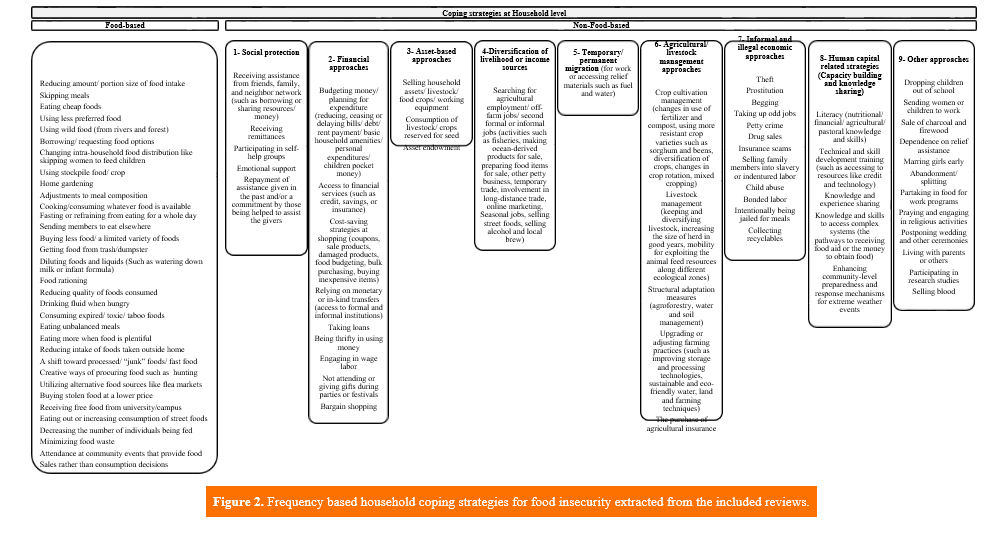
Three reviews specifically addressed the coping strategies of women or children (Awiti, 2022, Chaudhuri et al., 2021, Ivers and Cullen, 2011). Moreover, Sulaiman et al. (Sulaiman et al., 2021) mentioned women’s alternative income strategies like collecting jungle produce/wild foods, making ocean-derived products for sale, preparing food items for sale, collecting recyclables and sewing. Also, Douglas et al. (Douglas, 2023) reported coping strategies in households with infants including watering down milk or infant formula and/or using food substances other than infant formula. Figure 2 presents key findings from this comprehensive review of coping strategies households use in response to food insecurity. These strategies are categorized into two main groups: Food-based and non-food-based coping strategies.
In the food-based group, strategies range from reducing portion sizes to utilizing private or public assistance programs that include food banks, emergency food aid, charitable feeding systems, and assistance from NGOs (Non-Governmental Organizations), multilateral agencies, and private donors. Reducing meal frequency and portion sizes was the most frequently reported strategy, reflecting an immediate response to food shortages. Utilizing alternative food sources, foraging, scavenging, and consuming less desirable foods were moderately frequent. The consumption of wild plants during drought periods in Sub-Saharan Africa is an example for this strategy. Stockpiling food is less frequent but noted in areas with seasonal food insecurity.
The non-food-based category features nine distinct strategies, listed from most to least frequent: social protection, financial approaches, asset-based strategies, diversification of income sources, temporary or permanent migration, agricultural and livestock management, informal and illegal economic activities, human capital development (capacity building and knowledge sharing), and other approaches. Items in each category are arranged in descending order of frequency. Economic adjustments such as selling assets like land or livestock was a common strategy, mainly in rural areas, which are critical in response to food insecurity. Borrowing money or buying food on credit was common, highlighting the importance of informal financial networks. Among non-food-based coping strategies, asset-based approaches, migration, and diversification of livelihood or income sources are common mechanisms in LMICs. Also, agricultural/ livestock management approaches are more usual in LMICs.
Discussion
This overview of reviews highlighted the two major groups of coping strategies facing food insecurity in households. Other classifications, such as financial and nutritional coping strategies, have also been mentioned.
Food-based coping strategies
Prolonged use of coping strategies like reducing amount/portion size of food intake, skipping meals, staying hungry, buying less food/ a limited variety of foods, diluting foods and liquids, food rationing, reducing quality of foods consumed or drinking fluid when hungry could be a high risk for undernourishment. It can exacerbate the burden of malnutrition and related diseases in food insecure people (Tsegaye et al., 2018).
About eating cheap foods and using less preferred food, however, there is no clear definition of cheap food; but households switch to cheaper, often less preferred, or lower quality staples to protect energy intake. This is important, because prolonged consumption of energy dense or nutrient poor foods has been linked to nutritional deficiencies and chronic diseases (Ruel et al., 2010, Watson et al., 2022). In addition, it is possible that some people perceive healthy foods as costly, leading them to a shift toward processed/ “junk” foods/ fast food. Nevertheless, understanding how to mix and match different foods to boost their nutritional content is crucial (Munialo and Mellor, 2023). Therefore, the policymakers should consider promoting access to affordable, nutritious, and preferable food options, to counteract these trends.
Chhay et al. (Chhay et al., 2023) suggested that it is essential to incorporate wild food considerations into food security policies at regional, national, and international levels in order to enhance resilience and decrease vulnerability in rural communities. In Nigeria, for instance, indigenous communities have turned to alternative food sources such as wild baobab trees to mitigate food shortages, showcasing how traditional knowledge and biodiversity conservation contribute to food security resilience (Salami et al., 2025).
Coping strategies like borrowing or requesting food options, food sharing or sending members to eat elsewhere need social interaction with others. However, this shows kindness and benevolence, yet it also highlights the portrayal of food insecurity as a problem to be tackled by individuals, rather than through government and policymakers (Watson et al., 2022). These tactics might provide temporary relief but can lead to long-term dependency, social stigma, or tension in relationships, highlighting the need for broader policy reforms to address fundamental causes like economic disparity and access to resources.
Changing intra-household food distribution like skipping meal by adults (particularly by women) to feed children was a common coping strategy that obviously has significant nutritional, psychological, and social impacts on both adults and children. Leung et al. (Leung et al., 2020) reported that children are worried about not having enough food and their parents’ wellbeing, and embarrassed about their family’s food situation. These emotional burdens can affect children’s mental health, social relationships, and educational performance. Thus, it seems essential to develop policies that encourage fair food distribution in households, supported by targeted nutrition assistance and awareness programs, to alleviate these impacts and protect the well-being of all individuals.
Using stockpile food/ crop or eating more when food is plentiful among those experiencing severe food shortages can lead to health issues, potentially contributing to the development of obesity and NCDs (Non-Communicable Diseases)(Douglas, 2023). Although this approach might provide short-term abundance during surplus periods, it often conceals persistent vulnerabilities without tackling underlying factors like agricultural instability or economic obstacles, highlighting the necessity for policy-driven solutions such as developed food distribution networks and nutrition education initiatives.
Saediman et al. (Saediman et al., 2021) reviewed the global experiences of home gardens and highlighted the positive effects on food availability, access, and utilization. Despite these benefits, enhancing food stability through such programs remains a difficult endeavor that should be addressed by relevant entities.
Adjustments to meal composition/ food variations/ cooking method and cooking/consuming whatever food is available at home usually involves reducing the consumption of animal-based products or vegetables and replacing them with unhealthy spices and artificial flavors. Consequently, there is a decrease in the variety and nutritional value of the diet (Ruel et al., 2010). Such adaptations could worsen micronutrient deficiencies and long-term health risks such as compromised immunity or chronic diseases, underscoring the importance of combining accessible food subsidies and community-based nutrition programs to promote sustainable dietary habits.
The right to food includes the right to nourish oneself with dignity, required consistent access to the means necessary for food production, income generation, or food purchase and does not typically contain entitlement to free provisions. This right aims not only to alleviate hunger, but also to promote overall health and well-being. Apparently, coping strategies like getting food from trash/dumpster and consuming expired/ toxic/ taboo foods or buying stolen food at a lower price are completely at odds with this right. These behaviors often expose individuals to significant health risks, social stigma, and legal challenges, highlighting the need for comprehensive interventions such as strengthened social welfare networks, poverty alleviation programs, and community support systems to maintain dignity and ensure sustainable access to safe and nutritious food.
Like the observation of conflicting coping strategies such as reducing intake of foods taken outside home/ increasing home prepared food consumption and eating out, a recently published systematic review reported large heterogeneity in LMICs in the definition of food consumed away from home and the methods used to measure it, and subsequently, difficulty in making comparisons and syntheses. However, like high-income nations, the consumption of food outside the home in LMICs had negative impacts on an individual's diet quality, nutritional status, and overall health (Landais et al., 2022). Therefore, there were unintended consequences such as the nutritional risks linked to increased reliance on street foods or the economic burden of shifting to home-prepared meals or shifting to eating out which may vary significantly across settings and populations. Therefore, in each nation, context-appropriate education for consuming nutritious and more affordable foods should be planned.
Decreasing the number of individuals being fed by the household is a coping strategy in situation of extreme food insecurity. This meant sending some members or complete family members to eat elsewhere such as religious places or community events that provide food and in the worst situation, migration of one or more family members (Gupta et al., 2015). While this approach might provide short-term relief for household resources, it can also lead to social disintegration, emotional distress, and enhanced vulnerability of those who relocate, especially children and elderly peoples. Additionally, dependence on external food sources may not ensure consistent access to nutritious meals, possibly worsening malnutrition and health risks over time.
Receiving free food from university/campus is a coping strategy in postsecondary students in wealthy countries. Evaluation of such strategies is necessary to reduce negative academic, nutritional and health outcomes (Lee et al., 2018).Without proper oversight, these strategies might fail to deliver balanced, culturally suitable, or reliably accessible meals, possibly continuing unhealthy eating habits and stress-related health problems. Understanding this strategy can guide us to better support student well-being and academic success.
A striking paradox arises when considering death of thousands of individual from hunger and malnutrition each day, while approximately one-third of food, is wasted worldwide. Consequently, households must devise strategies to minimizing food waste, which may involve revaluing leftovers as a means of managing excess food. This is an opportunity to give food a 'second chance' (Munialo and Mellor, 2023). Beyond personal efforts, governments can significantly contribute by implementing policies that promote food recovery, boost supply chain efficiency, and support timely storage and distribution of staple foods. Such synchronized planning can help bridge the gap between surplus and scarcity, ultimately leading to enhanced food security and reduced environmental effects.
The issue with harvesting immature crops as a coping strategy is less yield and nutritional content than when harvesting fully ripe crops (Finch, 2024). Although this method might provide temporary relief in times of acute food scarcity, it compromises long-term food security by reducing the overall efficiency of agricultural systems. Furthermore, continual reliance on premature harvesting can interfere with planting cycles and soil condition, further exacerbating vulnerability in already food-insecure communities.
The last coping strategy in this group was using private or public assistance programs mostly common in HICs. In a review by Loopstra (Loopstra, 2018), community-level interventions such as food banks have shown limited impact, largely due to their dependence on donations and the stigma associated with their use. While alternatives like community kitchens are emerging, their effectiveness is also constrained if they fail to reach those in need. Also, Loopstra et al. (Loopstra and Lambie-Mumford, 2023) recently reviewed the literature on food insecurity and the use of food banks in the UK, noting that while food banks provide some support, many individuals experiencing food insecurity do not seek assistance from them. It explores the complex relationship between food insecurity and food bank usage, influenced by the nature of available services and individual circumstances. The effectiveness of food banks in alleviating food insecurity also depends on the quality and quantity of food provided, along with additional services. Moreover, a mixed-method systematic review by Oldroyd et al. (Oldroyd et al., 2022) investigated the nutritional adequacy of food parcels provided by food banks and their impact on food insecurity and dietary intake among users. The review revealed that food parcels often fail to meet nutritional requirements and individual needs, such as cultural and health preferences. While food banks improve food security and dietary quality for users, challenges remain due to limited food variety and quality. Therefore, due to causes like stigma, shame, low food quality, and limited choice in these services, some food insecure individual prefer illegal or risky options such as theft, taking up odd jobs, eating other people’s leftovers, or skipping meals rather than use food assistance programs (Watson et al., 2022). To resolve these challenges, policymakers must ensure that food assistance programs are accessible, stigma-free, and provide nutritionally sufficient, culturally appropriate, and high-quality food. Strengthening these programs in this manner can improve participation, better meet the needs of vulnerable populations, and diminish reliance on harmful coping mechanism or crisis-level survival responses such as theft, prostitution, child labor, early marriage, bonded labor, selling blood, and intentionally being jailed for meals.
Non-food-based coping strategies
Social protection strategies involve the redistribution of resources within a community through various institutions, such as the family unit. Resource sharing among community members is grounded in the principle of reciprocity that have extensive spectrum. However, if a food deficit persists for an extended period, the effectiveness of these reciprocal actions will diminish. Social disintegration may manifest in informal and illegal economic approaches such as theft and begging (Campbell, 1990). To mitigate these risks, policymakers need to prioritize establishing robust, context-aware social safety nets that not only offer immediate assistance but also strengthen community resilience against long-term food insecurity.
In the field of financial approaches, volatility in income and expenditures can forecast a household's capacity to meet their food requirements. Financial adjustments, which can include relying on savings, seeking assistance from relatives and friends, and intensifying work endeavors, are linked with marginal food security. As food insecurity worsens, households may resort to less favorable forms of credit, such as payday and pawn loans. In fact, understanding the extent of a household's food-related challenges offers valuable information about the types of financial tactics they may have employed (Bartfeld and Collins, 2017). Recognizing the scope of a household's food-related challenges provides valuable insight into the financial strategies they might have employed. This knowledge is essential for policymakers, as it can guide the design of targeted financial aid programs that tackle both urgent needs and decrease reliance on risky borrowing while encouraging long-term economic stability. However, in the absence of protections, such initiatives could unintentionally strengthen dependency or fail to reach the most vulnerable, highlighting the necessity for inclusive and closely monitored implementation.
Asset-based approaches are indicators for indexing resilience capacity. Therefore, a household possessing more assets is expected to have a higher level of resilience against unexpected events that may jeopardize food security through consumption smoothing (Ansah et al., 2019). However, the prolonged success of these strategies relies on the quality, liquidity, and sustainability of the assets.
Diversification of livelihood or income can enhance households’ access to food and subsequently reduce food insecurity (Etea BG, 2019).This approach enhances financial security and boosts resilience by reducing reliance on one income source. However, its effectiveness relies on access to resources, markets, and skills, and may be restricted in contexts with limited economic opportunities or systemic barriers.
In addition to temporary/ permanent migration (for work or accessing relief materials such as fuel and water), about the link between food insecurity and international migration, the solution is to link investments in reducing food insecurity and increasing productivity to broader economic growth (Laborde et al., 2017). Food insecurity both drives and results from migration, particularly when local livelihoods are insufficient. To tackle this, investments need to focus on food security and agricultural productivity as well as wider economic development. Establishing off-farm opportunities such as small businesses and rural services can also diminish migration pressure, enhance resilience, and promote inclusive growth.
Thus, agricultural/ livestock management approaches are highly recommended. In this context, a review study showed that the implementation of an integrated crop and livestock system within a farming enterprise could significantly enhance income generation and provide a diverse food supply to support the livelihoods of farmers, particularly in LMICs, if managed effectively. Moreover, it can elevate socio-economic outcomes and improve environmental impacts (Sekaran et al., 2021). To maximize these benefits, governments and relevant organizations must proactively encourage agricultural and livestock management practices via targeted policy aids, extension services, and financial access. However, the long-term success of these methods relies on elements like market accessibility, suitable infrastructure, and adaptability to climate fluctuations.
Human capital involves utilizing individual resources like education, experience, skills, and opportunities. This capital can be utilized to navigate through periods of food insecurity (Piaskoski et al., 2020).The effectiveness of these strategies, however, often relies on the wider socio-economic context, including the presence of job opportunities, access to education, and supportive policies.
Finally, the authors identified approaches that do not fit neatly into specific categories, referring to them as other approaches. These include actions such as withdrawing children from school, praying, engaging in religious activities, postponing weddings, and ceremonies, participating in research studies, or selling blood. These strategies can lead to diverse personal and social outcomes and may result in various personal, social, and even ethical effects that some offer short-term relief, while others have long-term adverse consequences on well-being, education, and social cohesion. It is recommended that policymakers embrace a comprehensive, cross-sectoral strategy that includes diverse methods while prioritizing community involvement, social support networks, and mental health resources. This can help guarantee that interventions tackle both the urgent challenges of food insecurity and its wider human impacts.
The included reviews encompass diverse contexts, including climate change, drought, conflict, COVID-19, migration, poverty, and humanitarian crises. These represent fundamentally different drivers of food insecurity and coping behaviors. The interconnected challenges underscore the need for a holistic approach to food security, integrating climate adaptation, economic resilience, political stability, and social empowerment at household and governmental levels. Addressing food insecurity requires not only immediate interventions but also long-term policies. Therefore, policymakers and planners must collaborate to develop comprehensive policies that not only alleviate food insecurity but also enhance overall health and well-being in communities.
Strengths and limitations: This study introduces a comprehensive and frequency-based list of coping strategies in households facing food insecurity, which has not been extensively explored in previous research. However, frequency of reporting does not necessarily indicate the prevalence, effectiveness, or policy importance of a coping strategy. Moreover, some included reviews did not report the context of their studies, and others were multi-country analyses, preventing a comparison of coping strategies between HICs and LMICs. The protocol for this review was not registered in PROSPERO (International prospective register of systematic reviews); however, this did not significantly affect the methodological transparency, which was based on PRISMA. The potential overlap of initial studies may lead to some of them contributing multiple times to the overall findings, potentially introducing bias. Language bias (restriction to English-language especially for evidences from LMICs), publication bias (review-type studies), exclusion of grey literature, and heterogeneity of included populations and settings could limit the global applicability, particularly marginalization of non-English-speakers and lower-income communities. Since some included reviews did not clearly report countries or settings, these comparisons should be considered more cautiously. Although methodological quality of included reviews was evaluated, the certainty of evidence supporting each category of coping strategies was not assessed. Consequently, policy recommendations should be presented more cautiously.
Conclusion
The present overview of reviews identified two major groups of household coping strategies for addressing food insecurity: 1) Food-based coping strategies, which range from reducing portion sizes to utilizing private or public assistance programs; and 2) Non-food-based coping strategies, which include social protection, financial approaches, asset-based strategies, diversification of income sources, temporary or permanent migration, agricultural and livestock management, informal and illegal economic activities, and human capital strategies (capacity building and knowledge sharing). Recognizing the wide range of coping strategies that households use to deal with food insecurity is crucial for policymakers, as it reveals both the difficulties these families face and the potential areas for effective support. The findings from this review may help shape focused policies that respond to the specific needs of at-risk groups and contribute to achieving the Sustainable Development Goals (SDGs). By organizing these strategies into clear categories, decision-makers can design more targeted responses. Still, to make sure these policies are both fair and effective, they should be based not just on how common these strategies are, but also on how well they work, which highlights the need for deeper evaluative research in future.
Acknowledgments
The authors would like to thank National Nutrition & Food Technology Research Institute (NNFTRI), Faculty of Nutrition Sciences and Food Technology, Shahid Beheshti University of Medical Sciences, Tehran, Iran supported this study. The researchers who made the present review possible through their valuable studies are all acknowledged by the authors.
Authors' contributions
Karkhaneh M and Shafiei F contributed to searching, data interpretation, result synthesis, and manuscript drafting. Mohammadi-Nasrabadi F and Pakravan-Charvadeh MR conducted conception, design, data interpretation, result synthesis and manuscript drafting. Moreover, Mohammadi-Nasrabadi F supervised the study. All authors approved the final manuscript for submission.
Conflict of interests
There is not any conflict of interest.
Funding
This study did not receive any funding.
References
Ahmad M & Farooq U 2010. The state of food security in Pakistan: Future challenges and coping strategies. Pak. Dev. Rev. 49 (4): 903-923.
Ahmed Mumed A, Berhanu Bonso A & Hassen Habib A 2023. Review on food in security status and its major coping strategies in rural Ethiopia. International journal of health economics and policy. 8 (1): 10-15.
Akbari M, et al. 2022. The evolution of food security: Where are we now, Where should we go next? Sustainability (Switzerland). 14 (6): 3634.
Alaimo K 2005. Food insecurity in the United States: An overview. Topics in clinical nutrition. 20 (4): 281–298.
Ansah IGK, Gardebroek C & Ihle R 2019. Resilience and household food security: a review of concepts, methodological approaches and empirical evidence. Food security. 11 (6): 1187 - 1203.
Ardalan A, et al. 2019. Impact of climate change on community health and resilience in Ethiopia: A review article. Hum antibodies. 27 (S1): 11-22.
Aromataris E, et al. 2015. Summarizing systematic reviews: methodological development, conduct and reporting of an umbrella review approach. JBI Evidence implementation. 13 (3): 132-140.
Awiti A 2022. Climate change and gender in Africa: A review of impact and gender-responsive Solutions. Frontiers in climate. 4: 895950.
Baethge C, Goldbeck-Wood S & Mertens S 2019. SANRA - a scale for the quality assessment of narrative review articles. Research integrity and peer review. 4 (1): 5.
Bartfeld J & Collins JM 2017. Food insecurity, financial shocks, and financial coping strategies among households with elementary school children in Wisconsin. Journal of consumer affairs. 51 (3): 519-548.
Bazerghi C, McKay F & Dunn M 2016. The role of food banks in addressing food insecurity: A systematic review. Journal of community health. 41 (4): 732-740.
Campbell D 1990. Strategies for coping with severe food deficits in rural africa: A review of the literature. Food and foodways. 4 (2): 143-162.
Castells-Quintana D, Lopez-Uribe M & McDermott T 2018. Adaptation to climate change: A review through a development economics lens. World development. 104: 183-196.
Chaudhuri S, Roy M, McDonald L & Emendack Y 2021. Coping behaviours and the concept of time poverty: A review of perceived social and health outcomes of food insecurity on women and children. Food security. 13 (4): 1049-1068.
Chhay P, Rahut D, Tashi S & Chamberlin J 2023. Does wild food contribute to food security? Evidence from rural Bhutan, https://hdl.handle.net/10419/296762.
Corbett J 1988. Famine and household coping strategies. World development. 16 (9): 1099-1112.
Dasgupta S & Robinson E 2022. Attributing changes in food insecurity to a changing climate. Scientific reports. 12 (1): 4709.
Deckard F & Auyero J 2022. Poor people's survival strategies: Two decades of research in the Americas. Annual review of sociology. 48: 373-395.
Dlamini S N CA, Mtintsilana A, Mapanga W, Du Toit J, Ware L J, Norris S A 2023. Food insecurity and coping strategies and their association with anxiety and depression: a nationally representative South African survey. Public Health Nutr. 24;26(4):1-11.
Douglas F 2023. What qualitative research can tell us about food and nutrition security in the UK and why we should pay attention to what it is telling us. Proc Nutr Soc. 1-10.
Endalew B, Muche M & Tadesse S 2015. Assessment of food security situation in ethiopia: A Review. Asian J. Poult.Agric. Res. 9 (2): 55-68.
Errico M PJ, Jumbe E, Hong Luu A 2023. Drivers and stressors of resilience to food insecurity: evidence from 35 countries. Food Securiy. 15.
Etea BG ZD, Abebe KA, Sedebo DA 2019. Household Income Diversification and Food Security: Evidence from Rural and Semi-Urban Areas in Ethiopia. Sustainability. 11(12):3232.
Falco C, Donzelli F & Olper A 2018. Climate change, agriculture and migration: A survey. Sustainability. 10 (5): 1405.
Fan Y, Shi X, Li X & Feng X 2022. Livelihood resilience of vulnerable groups in the face of climate change: A systematic review and meta-analysis. Environmental development. 44: 100777.
Fayemi P, Muchenje V, Yetim H & Ahhmed A 2018. Targeting the pains of food insecurity and malnutrition among internally displaced persons with nutrient synergy and analgesics in organ meat. Food research international. 104: 48-58.
Feichtinger E 1995. Poverty, health, nutrition and food: the state of affairs. Ernahrungs-Umschau. 42 (5): 162-169.
Few R 2003. Flooding, vulnerability and coping strategies: Local responses to a global threat. Prog. Dev. Stud. 3 (1): 43-58.
Finch C 2024. Optimizing harvesting techniques for improved yield and quality of agricultural crops. Agrotechnology. 13 (1): 1000355.
Food Security Information Network 2024. 2024 Global Report on Food Crises, https://www.fightfoodcrises.net/report/ global-report-food-crises-2024/.
Fyles H MC 2016. Key Drivers of Food Insecurity.
Gebrehiwota M DB, Meazaa H, Gezahegnc T W, Abbay A G, Beyene S 2023. Understanding food security determinants and coping strategies among smallholder farming households in Northern Ethiopia. Cogent SoCial SCienCeS.
Gupta P, Singh K, Seth V, Agarwal S & Mathur P 2015. Coping strategies adopted by households to prevent food insecurity in urban slums of Delhi, India. Journal of food security. 3 (1): 6-10.
Hadley C & Crooks D 2012. Coping and the biosocial consequences of food insecurity in the 21st century. American journal of physical anthropology. 149 (555): 72-94.
Haile M 2005. Weather patterns, food security and humanitarian response in sub-Saharan Africa. Philosophical Transactions of the Royal Society B. Biological sciences. 360 (1463): 2169-2182.
Hawkins M PA 2021. Food insecurity: A key determinant of health. Archives of Psychiatric Nursing.
Hoffmann R, Wiederkehr C, Dimitrova A & Hermans K 2022. Agricultural livelihoods, adaptation, and environmental migration in sub-Saharan drylands: A meta-analytical review. Environmental research letters. 17 (8): 83003.
Integrated Food Security Phase Classification 2015. IPC Chronic Food Insecurity Classification, https://www.ipcinfo.org/ipcinfo-website/ipc-overview-and-classification- system/ ipc-chronic-food-insecurity- classification/en/. IPC GLOBAL SUPPORT UNI.
Ivers L & Cullen K 2011. Food insecurity: special considerations for women. American journal of clinical nutrition. 94 (6): 1740s-1744s.
Kamdar N, Rozmus C, Grimes D & Meininger J 2019. Ethnic/racial comparisons in strategies parents use to cope with food insecurity: A systematic review of published research. Journal of immigrant and minority health. 21 (1): 175-188.
Kiehne E & Mendoza N 2015. Migrant and seasonal farmworker food insecurity: Prevalence, impact, risk factors, and coping strategies. Social work in public health. 30 (5): 397-409.
Kregg-Byers C & Schlenk E 2010. Implications of food insecurity on global health policy and nursing practice. Journal of nursing scholarship. 42 (3): 278-285.
Krishna RN, Majeed S, Ronan K & Alisic E 2018. Coping with disasters while living in poverty: A systematic review. Journal of loss and trauma. 23 (5): 419-438.
Laborde D, Bizikova L, Lallemant T & Smaller C 2017. What Is the Link Between Hunger and Migration?
Landais E, et al. 2022. Consumption of food away from home in low- and middle-income countries: a systematic scoping review. Nutrition reviews. 81 (6): 727-754.
Laraia B 2013. Food insecurity and chronic disease. Advances in nutrition. 4 (2): 203-212.
Lee S, et al. 2018. Food insecurity among postsecondary students in developed countries: A narrative review. British food journal. 120 (11): 2660-2680.
Leroy J, Ruel M, Frongillo E, Harris J & Ballard T 2015. Measuring the food access dimension of food security: A critical review and mapping of indicators. Food and nutrition bulletin. 36 (2): 167-195.
Leung C, et al. 2020. Understanding the psychological distress of food insecurity: A qualitative study of children's experiences and related coping strategies. Journal of the Academy of Nutrition and Dietetic. 120 (3): 395-403.
Leventon J LJ 2017. Local food sovereignty for global food security? Highlighting interplay challenges. Geoforum.
Long M, Gonçalves L, Stretesky P & Defeyter M 2020. Food insecurity in advanced capitalist nations: A review. Sustainability. 12 (9): 3654.
Loopstra R 2018. Interventions to address household food insecurity in high-income countries. Proceedings of the nutrition society. 77 (3): 270-281.
Loopstra R & Lambie-Mumford H 2023. Food banks: Understanding their role in the food insecure population in the UK. Proceedings of the nutrition society. 82 (3): 253-263.
Maynard M, et al. 2019. The experience of food insecurity among immigrants: a scoping review. Journal of international migration and integration. 20: 375-417.
Megerssa G & Bekere Y 2019. Causes, consequences and coping strategies of land degradation: Evidence from Ethiopia. Journal of degraded and mining lands management. 7 (1): 1953-1957.
Melese A 2021. Review on causes and coping sterategies of rural farm housholds' food insecurity in Ethiopia. International journal of applied and natural sciences (IJANS). 10 (1): 81-88.
Melton M 2018. Cropping in an age of captive taking: Exploring evidence for uncertainty and food insecurity in the seventeenth-century North Carolina piedmont. American antiquity. 83 (2): 204-223.
Mohamed AA 2017. Food security situation in Ethiopia: a review study. International journal of health economics and policy. 2 (3): 86-96.
Morales-Muñoz H, et al. 2020. Exploring connections-environmental change, food security and violence as drivers of migration: A critical review of research. Sustainability. 12 (14): 5702.
Morton J 2007. The impact of climate change on smallholder and subsistence agriculture. Proceedings of the national academy of sciences of the United States of America. 104 (50): 19680-19685.
Munialo C & Mellor D 2023. A review of the impact of social disruptions on food security and food choice. Food science and nutrition. 12 (1): 13-23.
O'Farrell P, Anderson P, Milton S & Dean W 2009. Human response and adaptation to drought in the arid zone: lessons from southern Africa. South African journal of science. 105 (1-2): 34-39.
Oldroyd L, Eskandari F, Pratt C & Lake A 2022. The nutritional quality of food parcels provided by food banks and the effectiveness of food banks at reducing food insecurity in developed countries: a mixed-method systematic review. Journal of human nutrition and dietetics. 35 (6): 1202-1229.
Omomowo O & Babalola O 2021. Constraints and prospects of improving cowpea productivity to ensure food, nutritional security and environmental sustainability. Frontiers in plant science. 12: 751731.
Otekunrin OA 2024. Assessing the prevalence and severity of global hunger and food insecurity: Recent dynamics and Sub-Saharan Africa's Burden. Sustainability. 16 (12): 4877.
Patel S, Mathew B, Nanda A, Pati S & Nayak H 2019. A review on extreme weather events and livelihood in Odisha, India. MAUSAM. 70 (3): 551-560.
Peng W, Dernini S & Berry E 2018. Coping with food insecurity using the sociotype ecological framework. Frontiers in nutrition. 5: 107.
Piaskoski A, Reilly K & Gilliland J 2020. A conceptual model of rural household food insecurity: A qualitative systematic review and content analysis. Family and community health. 43 (4): 296-312.
Pitt E, Gallegos D, Comans T, Cameron C & Thornton L 2017. Exploring the influence of local food environments on food behaviours: a systematic review of qualitative literature. Public health nutrition. 20 (13): 2393-2405.
Pollock M FR, Becker LA, Pieper D, Hartling L. 2024. Chapter V: Overviews of Reviews [last updated August 2023]. In: Higgins JPT, Thomas J, Chandler J, Cumpston M, Li T, Page MJ, Welch VA (editors). Cochrane Handbook for Systematic Reviews of Interventions version 6.5. Cochrane.
Renzaho A & Mellor D 2010. Food security measurement in cultural pluralism: Missing the point or conceptual misunderstanding? Nutrition. 26 (1): 1-9.
Rijal S, Gentle P, Khanal U, Wilson C & Rimal B 2022. A systematic review of Nepalese farmers' climate change adaptation strategies. Climate policy. 22 (1): 132-146.
Ruel M, Garrett J, Hawkes C & Cohen M 2010. The food, fuel, and financial crises affect the urban and rural poor disproportionately: a review of the evidence. Journal of nutritionr. 140 (1): 170s-176s.
Saediman H, et al. 2021. The contribution of home food gardening program to household food security in indonesia: A review. WSEAS Trans. Environ. Dev. 17 (1): 795-809.
Salami MF, et al. 2025. The role of wild baobab in addressing food insecurity among indigenous people in Northwestern Nigeria. Discover sustainability. 6 (1): 113.
Sekaran U, Lai L, Ussiri DA, Kumar S & Clay S 2021. Role of integrated crop-livestock systems in improving agriculture production and addressing food security – A review. Journal of agriculture and food research. 5: 100190.
Seligman H & Berkowitz S 2019. Aligning programs and policies to support food security and public health goals in the United States. In Annual review of public health, vol 40 (ed. J. Fielding), pp. 319-337.
Sewnet Y 2015. Causes and coping mechanisms of food insecurity in rural Ethiopia.
Shemyakina O 2022. War, conflict, and food insecurity. Annual review of resource economics. 14: 313-332.
Sherly Ardi Vantono SB, Luh Ade Ari Wiradnyani 2022. Mother’s Coping strategies toward Food Insecurity during COVID-19 Pandemic: A Review Article. World Nutrition Journal.
Sirany T, Tadele E, Aregahegn H & Wale D 2022. Economic potentials and use pynamics of sorghum food system in Ethiopia: Its implications to resolve food deficit. Advances in agriculture. 2022 (1): 4580643.
Siwar C, Ahmed F & Begum R 2014. Household food insecurity, nutritional outcome and coping strategies: Evidence from Malaysia. J. Food Agric. Environ. 12 (1): 19-23.
Sulaiman N, Yeatman H, Russell J & Law L 2021. A food insecurity systematic review: Experience from malaysia. Nutrients. 13 (3): 1-41.
Tabe-Ojong M, Nshakira-Rukundo E & Haile Gebrekidan B 2023. COVID-19 and food insecurity in Africa: A review of the emerging empirical evidence. European review of agricultural economics. 50 (3): 853-878.
Thomas R & Leatherman T 1990. Household coping strategies and contradictions in response to seasonal food shortage. European journal of clinical nutrition. 44: 103-111.
Tricco A, et al. 2018. PRISMA extension for scoping reviews (PRISMA-ScR): Checklist and explanation. Annals of internal medicine. 169 (7): 467-473.
Tsegaye AT, et al. 2018. Reducing amount and frequency of meal as a major coping strategy for food insecurity. Archives of public health. 76 (1): 56.
Vilar-Compte M, et al. 2021. Urban poverty and nutrition challenges associated with accessibility to a healthy diet: a global systematic literature review. International journal for equity in health. 20 (1): 40.
Watson M, Booth S, Velardo S & Coveney J 2022. The Orthodox and Unorthodox Food Acquisition Practices and Coping Strategies Used by Food Insecure Adults: A Scoping Review. JOURNAL OF HUNGER & ENVIRONMENTAL NUTRITION.
Wekeza S, Sibanda M & Nhundu K 2022. Prospects for organic farming in coping with climate change and enhancing food security in southern Africa: A systematic literature review. Sustainability 14 (20): 13489.
World Food Programme 2023. Livelihood coping strategies indicator for food security, guidance note, https://docs.wfp.org/api/ documents/WFP-0000147801/download/. World Food Programme.
Yusa A, et al. 2015. Climate change, drought and human health in Canada. International journal of environmental research and public health. 12 (7): 8359-8412.
Type of article: review article |
Subject:
public specific
| Rights and permissions | |
 |
This work is licensed under a Creative Commons Attribution-NonCommercial 4.0 International License. |
